
Few automotive frustrations are as universal as the sinking feeling when your car refuses to start. That moment of silence, a solitary click, or a labored, slow crank can instantly derail your day. While car starting system problems are common, the good news is they are often diagnosable and fixable. Understanding the symphony of components that work together to bring your engine to life is the first step toward becoming your own best diagnostician. This guide will provide you with a clear, step-by-step framework to identify whether you’re dealing with a simple battery issue, a failing starter motor, a problematic alternator, or a more elusive electrical fault.
The starting system is a high-demand electrical circuit with one critical job: to spin the engine fast enough to initiate combustion under its own power. It’s a team effort involving your battery, starter motor, solenoid, ignition switch, and a network of cables. A failure in any single component, or even in the connections between them, will result in a no-start condition. By learning to interpret the symptoms—the specific sounds and behaviors your car exhibits—you can move from panic to a plan.
Table of Contents
Understanding the Core Components of the Starting System
To effectively troubleshoot, you need a basic map of the system. Each part has a distinct role, and knowing these roles makes diagnosis logical.
The Battery: The Power Reservoir
Your car’s battery is the heart of the starting system. It doesn’t just power your radio and lights; its primary function is to store a massive amount of chemical energy and release it as a short, intense burst of electrical current (often 200-600 amps) to spin the starter motor. A weak or dead battery is the single most common culprit behind car starting system problems.

The Starter Motor: The Muscle
This powerful electric motor converts the battery’s electrical energy into mechanical rotation. When activated, a small gear on the starter (the pinion) extends and meshes with the teeth on the engine’s flywheel or flexplate. The motor then spins, which in turn cranks the engine’s crankshaft, allowing the pistons to begin their cycle.
The Starter Solenoid: The Heavy-Duty Switch
Mounted directly on the starter motor, the solenoid serves two vital purposes. First, it acts as a powerful electromagnetic relay. The small current from your ignition switch activates it, which then closes a set of heavy-duty contacts, allowing the full battery current to flow to the starter motor. Second, its plunger action physically shoves the starter’s pinion gear forward to engage with the flywheel. You often hear this action as a distinct “clunk” or “click.”
The Ignition Switch and Wiring: The Command Network
Turning your key to “START” (or pressing the start button) sends a signal through a network of wires. This circuit typically passes through a safety switch (like the park/neutral safety switch) before reaching the starter solenoid. This network uses thinner wires because it only carries the signal, not the heavy current needed for the motor itself. Problems here can interrupt the command before it ever reaches the starter.
The Alternator: The Recharger
While the alternator isn’t part of the starting event itself, it is critical to the system’s longevity. Once the engine is running, the alternator takes over electrical duty, recharging the battery and powering all vehicle systems. A failed alternator will lead to a depleted battery, causing car starting system problems the next time you try to drive.
Common Symptoms and Their Probable Causes
Your car communicates its distress through specific symptoms. Learning this language is your most powerful diagnostic tool.
Total Silence: No Click, No Crank, No Lights
You turn the key and absolutely nothing happens. The dashboard is dead, and there’s no sound from the engine bay.
- Likely Causes: A completely dead or disconnected battery, severely corroded or loose battery terminals, a blown main fuse, or a complete failure of the ignition switch.
- First Check: Test the interior dome light or headlights. If they don’t turn on, you have a total loss of power. Start your investigation squarely at the battery and its connections.
The Single, Solid “CLUNK”
You hear one pronounced click or clunk from the starter area, but the engine does not crank.
- Likely Causes: This usually indicates the starter solenoid is engaging (you hear the plunger click), but the main contacts inside are not passing current to the motor, or the starter motor itself has failed. It can also be a sign of a battery with just enough voltage to pull in the solenoid but not enough to power the motor.
- First Check: Check battery voltage. The classic “tap test”—gently tapping the side of the starter solenoid with a hammer or wrench while an assistant turns the key—can sometimes free stuck brushes or a stuck armature, confirming a failing starter.
Rapid, Frantic Clicking
A machine-gun-like series of clicks comes from the dash or engine compartment when you turn the key.
- Likely Causes: This is the hallmark of a weak or dying battery. There is enough voltage to pull the solenoid in, but the load instantly collapses the voltage, releasing it. The cycle then repeats rapidly. It can also be caused by an extremely poor ground connection.
- First Check: Attempt a jump-start. If the engine cranks normally and starts immediately with jumper cables, your battery is the primary suspect. The next step is determining why it died.
Slow, Labored Cranking
The engine turns over very slowly and sounds sluggish, like it’s dragging through molasses. It may or may not eventually start.
- Likely Causes: A weak battery is the most common cause. However, it can also point to a failing starter motor drawing excessive amperage (amps), high resistance in the battery cables or connections, or in rare cases, an engine with excessive mechanical friction (like severe oil thickening in extreme cold).
- First Check: A jump-start is very informative. If cranking speed returns to normal with a jump, focus on the battery, its age, and the charging system.
Normal Cranking Speed But No Start
The engine spins at its normal, healthy speed but never “catches” and runs. This is a critical distinction.
- Likely Causes: This symptom typically points away from classic car starting system problems. The starter, battery, and related circuits are likely functioning. The issue lies in another system required for combustion: fuel delivery (bad fuel pump, clogged filter), ignition (failed coils, bad sensors), or engine compression.
- First Check: Listen for the fuel pump’s brief hum when you first turn the key to “ON.” Note if the check engine light is illuminated, which can store valuable diagnostic codes.
(a) Step-by-Step Diagnostic Procedure
Follow this logical sequence to isolate the problem safely and efficiently. Always start with the simplest and most common fixes.
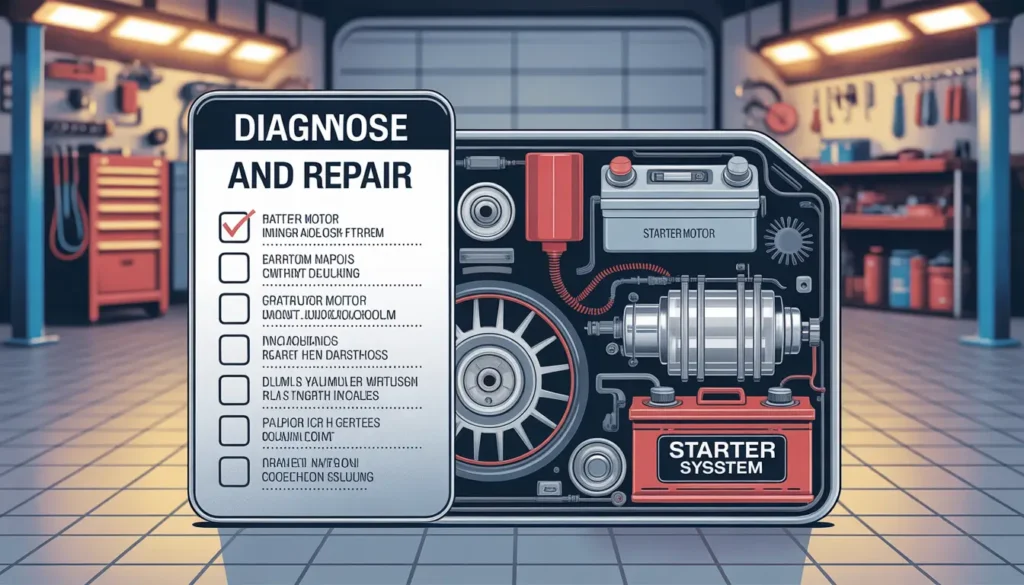
Step 1: Initial Visual and Sensory Inspection
Before reaching for tools, perform these basic checks.
- Transmission Position: Ensure the vehicle is firmly in “Park” or “Neutral.” An out-of-adjustment park/neutral safety switch can prevent the starter signal. Try starting in Neutral, or rock the shifter slightly while in Park.
- Battery Terminal Inspection: Open the hood and visually inspect the battery posts and cable clamps. Look for a thick, crusty, white, blue, or green corrosion buildup. Ensure the connections are physically tight and cannot be twisted by hand.
- Listen for System Activation: Turn the key to the “ON” position (but not to “START”). You should hear the fuel pump prime for 1-2 seconds (a hum from the rear) and see all warning lights illuminate on the dash. A silent fuel pump can indicate a fuse, relay, or pump failure.
Step 2: Testing the Battery and Connections
Over 70% of starting issues originate here.
- The Headlight Test: Turn on the headlights to a normal beam. Observe their brightness. Now, try to start the car while watching the lights. If they go extremely dim or go out completely during the crank attempt, it strongly confirms the battery is weak or connections are poor. If the lights stay perfectly bright and nothing else happens, the issue may be with the ignition switch or starter control circuit.
- Voltage Testing with a Multimeter:
- Resting Voltage: With the car completely off, set your multimeter to DC Volts (20V scale). Touch the red probe to the battery’s positive (+) terminal and the black probe to the negative (-) terminal. A fully charged battery should read approximately 12.6 volts. 12.4V indicates about 75% charge, and 12.0V or less signifies a discharged or failing battery.
- Cranking Voltage: This is the critical test. Have an assistant crank the engine while you watch the multimeter. A healthy battery will maintain a voltage above 10.0 volts during the crank attempt. If the voltage dips and holds below 9.6 volts, the battery likely cannot deliver the required current and should be replaced or professionally load-tested.
Step 3: Isolating the Starter and Control Circuit
If the battery tests strong, the focus shifts to the starter motor and the signal that commands it.
- The Control Signal Test: Locate the small wire (usually a single push-on connector) on the starter solenoid. This is the “S” or “ST” terminal. Using a multimeter or test light, check for 12 volts on this wire while an assistant holds the key in the “START” position.
- If you HAVE 12 volts here: The control circuit (ignition switch, safety switches, wiring) is working correctly. The fault lies with the starter/solenoid assembly itself.
- If you HAVE NO POWER here: The problem is upstream. The issue could be a faulty ignition switch, a malfunctioning park/neutral safety switch, a bad starter relay (if equipped), or an issue with the vehicle’s anti-theft system (immobilizer).
- Voltage Drop Testing (Advanced): This test finds hidden resistance that steals power. Set the multimeter to DC Volts.
- Positive Side Test: Place the red probe on the battery’s positive post (metal, not the clamp). Place the black probe on the starter’s main power terminal (the large post with the big cable). Have an assistant crank. A reading of more than 0.5 volts indicates excessive resistance in the positive cable or its connections.
- Ground Side Test: Place the red probe on the battery’s negative post and the black probe on a clean, unpainted spot on the engine block or the starter housing itself. Crank again. A reading of more than 0.2 volts indicates a poor ground connection.
Deeper Dive: Component Failure Analysis
Battery Life and Failure Modes
Car batteries are consumable items with a typical lifespan of 3-5 years. Extreme heat is their biggest enemy, accelerating internal corrosion. Classic signs of failure include slow cranking, a swollen battery case, a sulfurous (rotten egg) smell, and the need for frequent jump-starts. Pro Tip: Have your battery and charging system tested with a professional-grade load tester or conductance tester at least twice a year, ideally before summer and winter.
Starter Motor Wear and Tear
Starters fail due to worn-out carbon brushes, a seized armature bearing, or damaged solenoid contacts. A starter that draws excessive current (measured with a DC amp clamp) will drain a good battery quickly. A loud grinding noise during engagement often signals worn flywheel teeth or a failing starter drive gear. A high-pitched whirring without engine cranking usually means the solenoid is not engaging the drive gear (a condition called “freewheeling”).
The Alternator’s Role in Starting Problems
A failed alternator is a root cause of future car starting system problems, not an immediate one. If the alternator stops charging, the vehicle will run solely on the battery until it’s depleted, leaving you stranded later. Key symptoms of alternator failure include:
- Illuminated battery or charging warning light on the dash.
- Dimming or flickering headlights, especially at idle.
- Electrical accessories (windows, seats) moving slower than usual.
- A growling or whining noise from the engine that changes with RPM.
- A dead battery after the car has sat, despite having started fine previously.
When to Call a Professional Mechanic
While empowering, DIY diagnostics have limits. Seek professional assistance if:
- Your diagnostics point to a faulty ignition switch or complex wiring harness issue.
- The starter motor is located in a notoriously difficult position (common in many transverse-engine, all-wheel-drive, or V6/V8 configurations).
- The problem is intermittent and you cannot reliably reproduce it for testing.
- You suspect an issue with the vehicle’s immobilizer or anti-theft system.
- Tests indicate a possible mechanical engine problem (e.g., a seized component causing excessive cranking resistance).
- You are uncomfortable working with high-current electrical systems.
Proactive Prevention: A Maintenance Checklist
- Annual Battery Service: Clean terminals with a baking soda/water solution and a wire brush. Apply a thin coat of dielectric grease or terminal protector to prevent future corrosion.
- Biennial System Test: Have your battery, starter current draw, and alternator output tested professionally every two years, or at the first sign of slow cranking.
- Belt and Connection Inspection: During oil changes, visually inspect the alternator drive belt for cracks and glazing. Ensure the battery hold-down is secure to prevent vibration damage.
- Mind Your Electrical Load: Avoid leaving accessories (dome lights, phone chargers, aftermarket electronics) on when the engine is off for extended periods. This prevents parasitic battery drain.
- Address Symptoms Early: Slow cranking on a cool morning is a warning. Don’t wait for a complete failure in a parking lot.
Conclusion
Car starting system problems can transform a reliable vehicle into a source of anxiety, but they don’t have to. By adopting a systematic diagnostic approach—starting with the simple, visual checks at the battery and progressing through voltage tests and signal verification—you can demystify the no-start condition. Remember, the system is a chain of interdependent components: the battery supplies the power, the cables deliver it, the solenoid acts as the switch, and the starter motor provides the torque. A failure in any link breaks the sequence. Equipping yourself with this knowledge not only saves time and money but also provides the confidence to understand your vehicle’s needs. With regular preventative maintenance and a logical troubleshooting mindset, you can ensure that the simple act of starting your car remains a moment of reliable ignition, not a frustrating puzzle.
Frequently Asked Questions (FAQ)
What is the most common cause of car starting problems?
The single most common cause is a weak or dead battery, often due to age, terminal corrosion, or a failing alternator that hasn’t been recharging it properly.
Can a bad alternator prevent a car from starting?
A bad alternator itself will not prevent a car from starting if the battery is fully charged. However, it will fail to recharge the battery while driving, leading to a depleted battery and a no-start condition the next time you try to use the car.
What does a grinding noise during starting usually mean?
A grinding noise during the starting process typically indicates a problem with the engagement between the starter pinion gear and the engine’s flywheel teeth. This could be due to worn teeth on the flywheel, a faulty starter drive mechanism, or a misaligned starter motor.
How can I tell if my starter solenoid is bad?
Key signs of a bad solenoid include hearing a single loud click without the engine cranking, the starter motor spinning but not engaging the engine (freewheeling), or no sound at all when you have confirmed the battery and ignition signal are good.
Is it safe to jump-start a modern computer-controlled car?
Yes, but it must be done correctly to avoid damaging sensitive electronics. Always connect the positive (red) cables first, connect the negative (black) cable to a bare metal engine bracket or chassis point on the dead car (not the battery terminal), and ensure the donor car is running before attempting to start the dead car. Consult your owner’s manual for specific instructions.
Why does my car start sometimes and not others?
Intermittent starting problems are often caused by failing components that work only when cold/hot, or by loose/corroded wiring connections that make contact sporadically. A failing ignition switch, a weak starter motor, or a poor ground strap connection are common culprits.
How much does it typically cost to fix a starting system problem?
Costs vary widely. A new battery may cost $150-$300 installed. A starter motor replacement can range from $400 to $800+ depending on the vehicle’s make, model, and labor difficulty. Diagnosing a complex electrical fault may incur a 1-2 hour labor charge ($100-$300) before repairs even begin.