
Norway Electric Cars Problems: What 98% EV Adoption Hides About Reliability and Cost
Norway is the undisputed world champion of electric vehicle adoption. With EVs commanding over 98% of new car sales in recent months, the Nordic nation has achieved what every other country dreams of . But beneath this green success story lies a complex reality. The Norway electric cars problems are becoming impossible to ignore—from maintenance nightmares hidden by inspection data to a sudden subsidy phaseout that’s sent shockwaves through the market.
You might think owning an EV in Norway is paradise. No oil changes, cheap electricity, and the satisfaction of zero-emission driving. But as thousands of Norwegian owners are discovering, electric cars come with their own unique headaches. Brakes that rust from underuse. Suspension components that wear out faster due to battery weight. And a government that’s pulling the financial rug out just as the market matures.
This article pulls back the curtain on the Norwegian EV experiment. We’ll explore what’s really happening with maintenance costs, why Tesla has fallen from grace, and how the end of tax breaks is reshaping the market. Whether you’re considering an EV or just watching the transition unfold globally, Norway’s problems offer valuable lessons.
Table of Contents
The Norwegian EV Miracle: A Quick Overview
Before diving into the problems, we need to acknowledge the scale of what Norway has achieved. Through aggressive policy measures—including VAT exemptions, road tax elimination, and perks like free municipal parking—the country pushed EV adoption from niche to norm .
By September 2025, pure electric vehicles hit a staggering 98.3% of new car sales . The government’s 2025 target of all new cars being zero-emission is effectively achieved. Finance Minister Jens Stoltenberg recently declared, “We have had a goal that all new passenger cars should be electric by 2025, and… we can say that the goal has been achieved” .
But here’s the catch: 70% of cars on the road still burn fuel . The fleet transition is far from complete, and the Norway electric cars problems we’re about to explore affect both new and aging EVs.
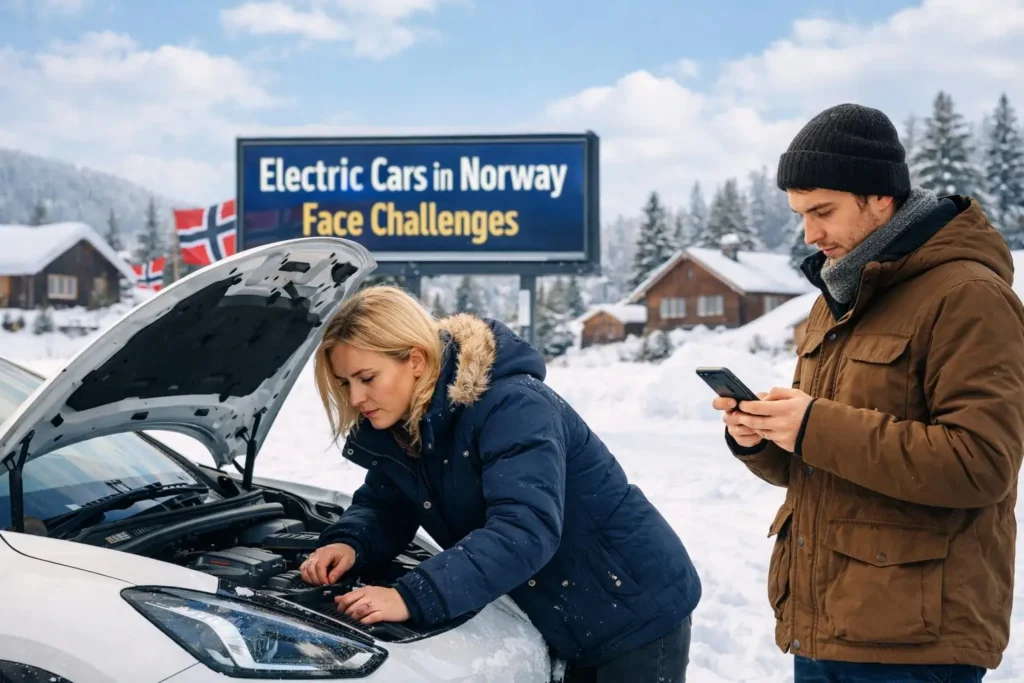
Hidden Norway Electric Cars Problems: The Maintenance Myth Debunked
The biggest misconception about EVs is that they’re maintenance-free. New data from Norway’s public roads authority destroys this myth completely.
Inspection Data Reveals Shocking Truths
According to fresh government vehicle inspection reports, electric cars receive nearly twice as many inspection remarks as comparable fossil-fuel cars of the same age . The statistics are stark:
- 30% of ten-year-old electric cars had faults at inspection
- Only 16% of gasoline cars of the same age showed similar issues
Andreas Forslund, vehicle technology expert at MEKO, explains: “This is not the first time these signals have appeared. When technology changes, wear patterns change as well. That places new demands on maintenance, expertise, and expectations of modern car ownership” .
The problems aren’t about battery or motor failure—they’re about components we thought would last longer.
Why Regenerative Braking Causes Rust Issues
Here’s an ironic Norway electric cars problem: EVs use their brakes less, which actually damages them faster.
Because electric cars slow down using the electric motor (regenerative braking), conventional brakes aren’t engaged regularly. This sounds great in theory—longer brake life, right? Wrong.
In practice, brakes that aren’t used frequently accumulate moisture, road salt, and grime. They rust. They seize. And by the time you actually need them for an emergency stop, they might not perform as designed .
Norwegian winters with heavy road salt exacerbate this. Owners who assume “less use = less maintenance” end up with failed brake inspections and expensive rotor replacements.
The Weight Problem: Tires and Suspension Wear
EVs are heavy. A typical electric car battery pack adds significant mass, and that weight affects everything downstream.
Tires on EVs wear out 20-30% faster than on comparable combustion vehicles. The combination of instant torque and high curb weight shreds rubber. Norwegian owners report replacing tires every 20,000-30,000 kilometers rather than the 40,000-50,000 they expected.
Suspension components also take a beating. Control arms, bushings, and shock absorbers are stressed by the constant heavy load. The inspection data confirms this: suspension issues appear far more frequently on aging EVs than on petrol cars .
The lesson? EVs require different maintenance, not no maintenance. Owners who ignore this face failed inspections and surprise repair bills.
Policy Shock: The End of VAT Exemptions
Perhaps the most immediate Norway electric cars problem right now is policy turbulence. After years of generous incentives, the government is pulling back—fast.
2026 Tax Threshold Changes Explained
Norway’s crown jewel incentive was always the VAT exemption. With VAT at 25%, avoiding it made EVs dramatically cheaper. Previously, EVs under 500,000 Norwegian crowns ($49,500) paid zero VAT. More expensive models paid VAT only on the portion above that threshold .
Starting in 2026, that threshold drops to just 300,000 crowns ($29,700) . Any amount above that triggers the full 25% VAT. By 2027, all exemptions disappear completely, with full VAT applying to every EV .
Finance Minister Stoltenberg justifies this: “The time is ripe to phase out the benefits” .
How Much Extra Will You Pay for a Tesla Model Y?
Let’s make this real with Norway’s best-selling vehicle. A base Tesla Model Y currently starts at 422,000 crowns .
Under the old rules: Zero VAT. Total savings compared to a combustion car: 105,500 crowns.
Under 2026 rules: The portion above 300,000 crowns (122,000 crowns) gets taxed at 25%. That’s an extra 30,500 crowns ($3,020) .
By 2027 with full taxation: Add another 75,000 crowns ($7,425) to the price .
Suddenly, that affordable Model Y costs significantly more. The Norwegian EV Association calls this “hasty” and warns it could push buyers back to fossil fuels .
The December 2025 Sales Spike and January 2026 Crash
The policy change created exactly what economists predict: a massive pull-forward effect.
December 2025 saw an insane 35,188 new cars registered as buyers rushed to beat the tax deadline . Then January 2026 arrived. Sales crashed 76.3% year-over-year to just 2,218 units .
This isn’t market weakness—it’s demand destruction from policy uncertainty. Brands that relied on incentives saw the biggest drops. Tesla plunged 88% in January 2026 compared to the previous January .
Tesla’s Trouble in Paradise: From Darling to “Hate List”
Tesla’s Norwegian story is particularly dramatic. Once the undisputed king, it’s now facing headwinds on multiple fronts.
Quality Control and Service Complaints
According to Professor Thor Øivind Jensen of the University of Bergen, “Tesla stands at the very top of the hate list of the Norwegian Automobile Association NAF and the Consumer Council” .
The main grievances?
- Too many technical problems
- Poor customer service
- Arrogant responses to complaints
For a country that embraced Tesla early, this sentiment shift matters. Owners who once evangelized the brand now warn others away.
The Elon Musk Factor
You can’t ignore the elephant in the charging station. Elon Musk’s political statements and public behavior have alienated many Norwegian buyers.
Robert Næss of Nordea Asset Management puts it bluntly: “If other business leaders had behaved like this, they would have been fired long ago” .
Many Tesla owners now literally distance themselves with stickers on their cars, signaling they bought despite—not because of—the CEO. A survey found two out of three Norwegians have a more negative view of Tesla than before .
Competitors That Are Eating Tesla’s Lunch
While Tesla struggles, traditional automakers are feasting. January-February 2025 sales data tells the story:
- Toyota bZ4X: +236.3%
- VW ID.4: +207.8%
- Nissan Ariya: +201%
- Tesla Model Y: -64.4%
Volkswagen boosted sales 224%, Toyota nearly doubled theirs . The message is clear: Norwegians have options, and they’re exercising them.
By January 2026, Volkswagen led the market with 19.9% share, while Tesla slumped to sixth place with just 3.7% .
The Charging Reality: Is Infrastructure Keeping Up?
With nearly every new car needing a plug, Norway’s charging infrastructure faces immense pressure.
While coverage is good in cities, rural areas and popular tourist routes experience bottlenecks—especially during holiday weekends. Fast-charger reliability remains an issue, with broken units and long queues frustrating drivers who expected “fueling” to be simpler.
The irony? Norway has more public chargers per capita than almost anywhere, yet success creates its own problems. More EVs mean more competition for plugs.
Cold Weather Performance: Range Loss and Charging Speeds
Norway isn’t called the land of the midnight sun for nothing—and its winters are brutal on EV batteries.
Real-world range loss of 20-40% in subfreezing temperatures is common. Heated cabins, heated seats, and battery conditioning all drain reserves. For owners without home charging (rare but growing), winter means constant range anxiety.
Charging speeds also plummet in the cold unless the battery is preconditioned—something not all drivers understand or remember.
Resale Value Concerns in a Maturing Market
Here’s a Norway electric cars problem that hits owners in the wallet: resale values.
With new EV prices potentially rising due to tax changes, you’d think used values might climb. But the market is flooded with off-lease EVs and trade-ins. Early models now suffer from:
- Battery degradation concerns
- Outdated technology
- Higher maintenance needs identified in inspections
Combine that with new competitors offering better range and features, and depreciation hits hard. Some owners discover their “economical” EV loses value faster than a comparable petrol car ever did.
What Norway’s Problems Mean for the Rest of the World
Norway is the laboratory for global electrification. What happens there eventually reaches other markets.
The maintenance data proves EVs aren’t set-and-forget appliances. Future owners everywhere will need education on brake care, tire selection, and suspension inspection. Workshops need training on EV-specific wear patterns .
The subsidy phaseout offers a template. Norway shows it’s possible to remove incentives if the market is mature enough . But do it too abruptly (as the U.S. did) and you crater demand .
Tesla’s Norwegian decline signals that brand loyalty isn’t guaranteed. As competition intensifies, customer service and reliability matter more than Musk’s mystique.
Finally, the charging and cold-weather lessons apply anywhere with real winters. Infrastructure planning must account for usage patterns, not just raw charger counts.
FAQ: Norway Electric Cars Problems
Are electric cars really less reliable than petrol cars in Norway?
Based on inspection data, ten-year-old EVs show nearly double the fault rate of equivalent petrol cars—but the issues are typically brakes, suspension, and tires, not the electric drivetrain itself .
Why do EV brakes fail more often if they’re used less?
Regenerative braking means friction brakes engage less frequently, allowing rust and corrosion to build up from moisture and road salt. Regular use is actually healthier for brakes .
How much will Norwegian EV prices increase under the new tax rules?
A Tesla Model Y could cost an extra 30,500 crowns ($3,020) in 2026 and another 75,000 crowns ($7,425) in 2027 as VAT exemptions phase out completely .
Why did Tesla sales crash in Norway?
Multiple factors: quality complaints, poor service, Elon Musk’s controversies, and intense competition from Toyota, Volkswagen, and Nissan . Tax policy changes amplified the drop .
Do Chinese EVs sell well in Norway?
Yes—brands like Deepal, MG, BYD, and Xpeng are gaining ground. Deepal S05 even hit #5 in车型销量榜 (model sales ranking) in January 2026, showing strong consumer acceptance .
What maintenance should Norwegian EV owners prioritize?
Regular brake cleaning/activation, tire rotations with wear monitoring, suspension inspections, and battery health checks. Don’t assume “no oil changes” means “no maintenance” .
Will other countries follow Norway’s subsidy phaseout?
Likely yes—once EV market share stabilizes above 50%, governments will question why they’re foregoing tax revenue. Norway’s gradual approach (over 2026-2028) offers a roadmap .
Conclusion
Norway electric cars problems reveal a nuanced truth: the EV transition isn’t a destination but an ongoing journey. The maintenance realities uncovered by inspection data remind us that all machines wear out—just differently. The policy turbulence shows that government support can vanish once political goals are “achieved,” leaving buyers exposed to higher costs. And Tesla’s fall from grace proves that even market leaders can stumble when quality slips and competitors catch up.
Yet Norway remains an EV success story. The market isn’t collapsing; it’s maturing. Buyers now choose from dozens of models. Workshops are adapting to new wear patterns. And the government is (clumsily) learning to balance fiscal responsibility with market stability.
For the rest of us watching, Norway offers an invaluable preview. The problems emerging there will eventually emerge everywhere. The question isn’t whether EVs have issues—it’s whether we’re prepared to handle them.
If you’re considering an EV, learn from Norway. Budget for maintenance. Research real-world cold weather performance. And don’t assume today’s incentives last forever. The electric future is coming—but like any future, it comes with fine print.